World
Chinese-Egyptian Air Drill Inadvertently Aids India's Rafale Fleet
By Dhruv Yadav
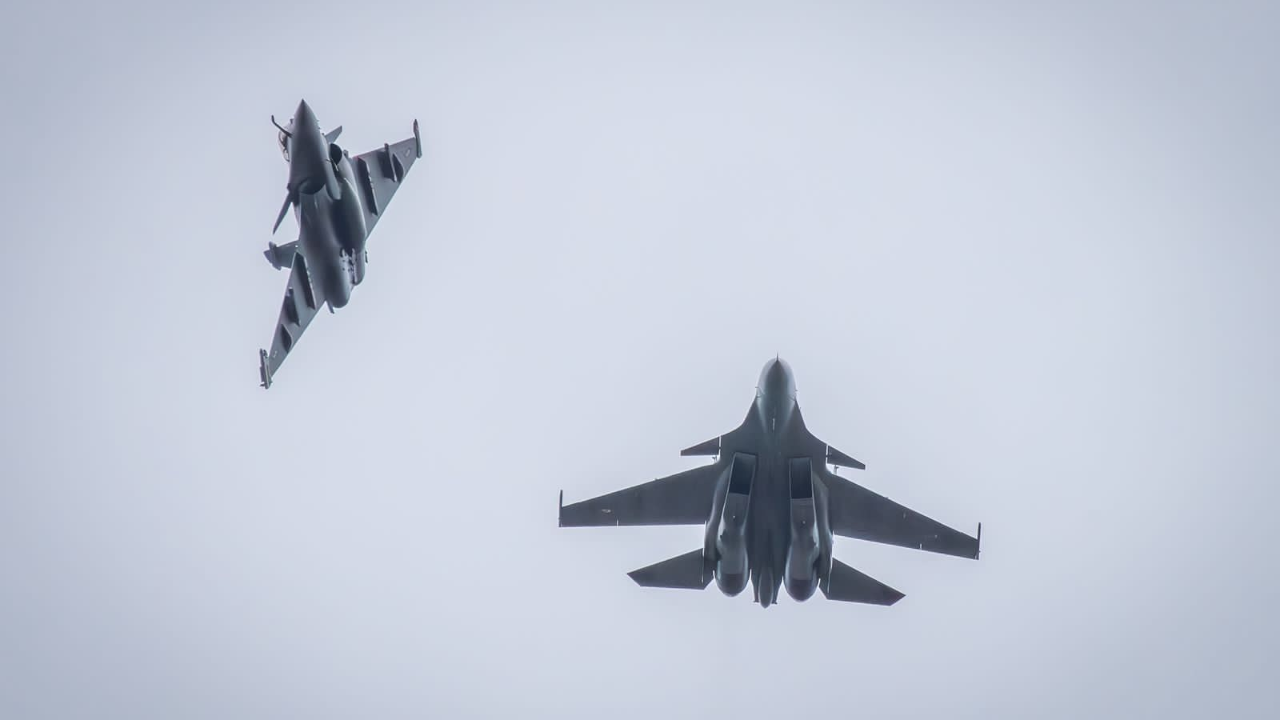
A joint military exercise between China and Egypt, known as Eagles of Civilisation, in which Beijing deployed its J-16 'Hidden Dragon' fighter jets, appears to have provided an unexpected advantage to India's air force rather than China's. While the exercise was widely seen as giving Chinese pilots their first close encounter with the Rafale, the same fighter jet that anchors India's air combat fleet, deeper analysis suggests the outcome may benefit the Indian Air Force more significantly.
The Indian Air Force currently flies 36 Rafale jets, with an additional 114 aircraft on order. Until India inducts a fifth-generation stealth fighter, the Rafale remains its most capable combat platform. Although it lacks the stealth shaping found in true fifth-generation aircraft, the Rafale compensates with advanced sensor fusion, network-centric warfare capabilities, and supercruise performance, features that place it near fifth-generation standards in most respects.
The Rafale's design follows an 'omnirole' concept, enabling a single aircraft to perform multiple functions during one mission, including striking targets, providing self-escort, designating targets with lasers, conducting electronic warfare through its SPECTRA defensive suite, and carrying out battle damage assessment. In actual combat scenarios, these roles are usually distributed among several aircraft rather than handled by one.
This is where the exercise in Egypt proved advantageous for India. Whenever a Rafale's SPECTRA system detects a hostile radar signal, such as the AESA radar used by China's J-16, it records that signature into a threat database. This data becomes part of a shared knowledge base accessible to the entire global fleet of Rafale operators, including the Indian Air Force, effectively strengthening India's readiness against similar radar systems in the future.