World
Miami Cargo Plane Crash: NTSB Says Five Ground Victims Were in Two Vehicles
By Today News Hours Editorial Desk
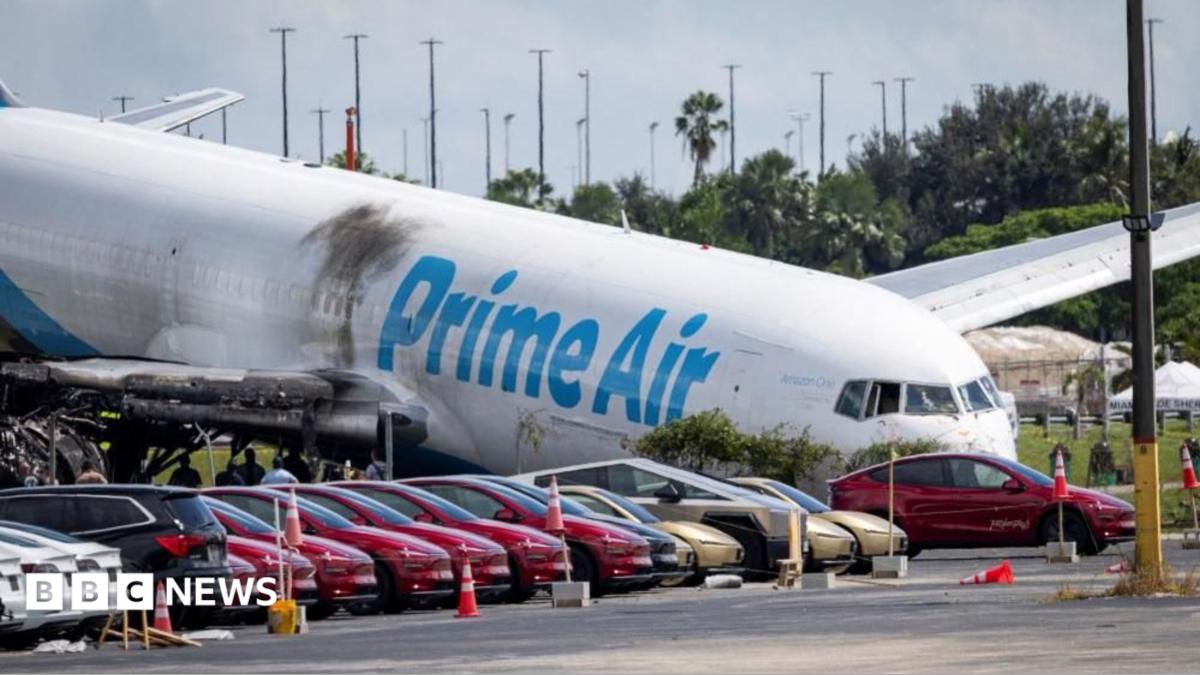
Investigators have confirmed that the five people killed and five others injured in Sunday's Amazon cargo plane crash at Miami International Airport were located in two separate vehicles on the ground. The Boeing 767-300, operated by 21 Air, overran the runway during landing, first striking an airline cleaning van carrying seven people before breaking through a perimeter fence and hitting a Toyota Corolla with three occupants inside. National Transportation Safety Board (NTSB) Chairwoman Jennifer Homendy described the crash site as a scene of "utter devastation" and cautioned that it remains too early to determine a cause. During a press conference at the airport on Monday, Homendy said the aircraft, which had two crew members aboard, was completing its third flight of the day after arriving from San Juan, Puerto Rico. After overshooting the runway, the plane damaged navigational equipment before colliding with a white Ford van belonging to a contract cleaning company. It then crashed through airport fencing and struck the Toyota Corolla, finally stopping roughly 1,300 feet (394 meters) past the end of the runway. Officials have not yet disclosed how many fatalities occurred in each vehicle or the condition of the two crew members. The crash left wreckage, damaged vehicles, and torn fencing scattered across the site. Homendy acknowledged the difficulty of the scene, saying, "It's hard to see, and I'm sure very difficult for the first responders as well." She emphasized that recovering victims remains the top priority, noting that the investigation and evidence collection could proceed afterward. Both the flight data recorder and cockpit voice recorder have been retrieved and sent to NTSB headquarters for analysis. Homendy said it was too soon to draw conclusions about what caused the crash, as evidence collection at the scene is ongoing. The investigation will examine the flight's history, the crew's experience and training, radar data, and the aircraft's performance. Separate teams will review the plane's systems and engines, while a meteorologist will evaluate weather conditions at the time of the incident. Investigators will also assess whether the runway should have been equipped with an engineered materials arresting system (EMAS), a technology designed to slow or stop aircraft that overrun runways. Homendy called this a