Law & Justice
Supreme Court Calls for End to Detentions Amid Delhi Protest Chaos
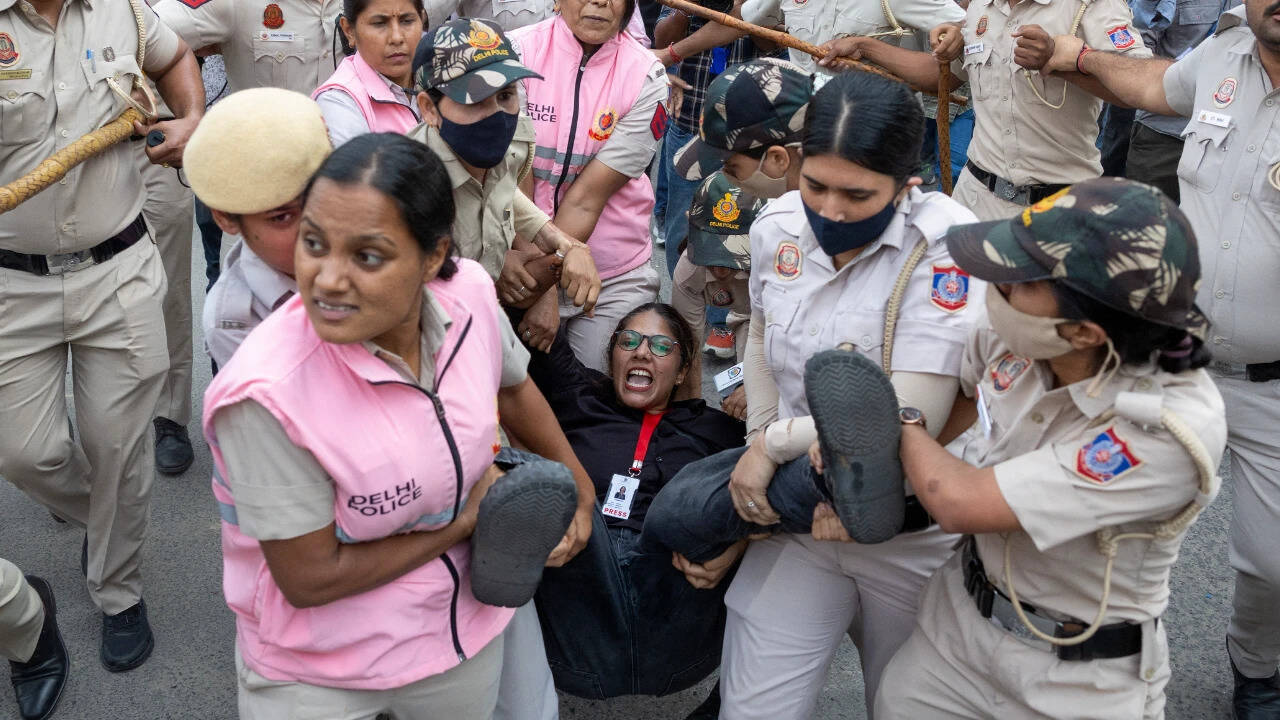
The Supreme Court on Sunday sought responses from Union Home Secretary Govind Mohan, Delhi Police Commissioner Anurag Kumar and Delhi Metro Rail Chief D Thara regarding a contempt petition alleging a prima facie violation of the court’s October 9 order that barred a complete shutdown of metro and train services in Delhi during Saturday’s protest against Chief Justice N. V. Ramana’s demand for Chief Election Commissioner Gyanesh Kumar’s resignation. The court also directed that lawyers, journalists and other professionals should not be hindered in performing their duties in any manner.
On the ground, nearly 700 people were detained, according to police figures of 400, many far from protest zones. Barricades and traffic curbs remained on the roads much as on Saturday. Protesters shifted tactics, staging flash protests in small numbers at short notice. Most activity was in and around Connaught Place (CP) where small groups of protesters kept trickling in and were detained.
At about 2:30 p.m., members of the All India Student Association, including president Neha Bora, began a protest near RK Ashram Marg metro station. When detentions began, Bora and a few others ran towards CP, where they continued to protest before being detained. At about 7 p.m., members of the Students Federation of India gathered at CP to hold a women’s tiranga march against alleged police excesses, especially against women protesters. They were detained and taken away in buses. “How can they detain women at 7 p.m. in the evening?” SFI general secretary Srijan Bhattacharya said.
The widespread detentions – 7,000 estimated on Saturday – were a key point in arguments by lawyers at the Supreme Court’s unusual holiday hearing on Sunday. Following submissions, a bench of Justices Joymalya Bagchi and V Mohana said, “we are of the opinion that the petitioners have made out a prima facie case. Accordingly, we issue notice upon the alleged contemnors.” The bench asked them to file responses by October 13.
The bench also asked for normalisation of internet connectivity and prohibition of “illegal” detentions, especially of those who gather for peaceful protest away from areas where prohibitory orders are in force. “There shall be no illegal detentions, particularly in cases of peaceful unarmed assemblage of people beyond the area where prohibitory orders under Sec 163 of BNS are in force,” it said.
On October 9, the Supreme Court had restrained authorities from resorting to blanket closure of metro stations, though it said operations could be regulated depending on the situation. The order came after DMRC said 57 stations would be shut; that number was later revised to 45. Solicitor General Tushar Mehta disputed allegations of violation of the October 9 order and said Delhi Metro was functioning normally, though 45 out of 303 stations were closed to maintain law and order. He refuted the allegation that metro stations were closed, saying that “all metro stations are open since 10 p.m. Saturday, trains are operating normally and internet connection has been restored.”
The Supreme Court also issued directions to ensure free movement in the city subject to law and order situation/traffic regulations and that installing barricades shall be reviewed forthwith to ensure free movement subject to law and order and traffic requirements. “Lawyers, journalists and other professionals shall not be hindered in discharge of their professional duties in any manner whatsoever,” the court said, and also directed withdrawal of prohibitory orders around the Supreme Court and courts to facilitate free access to litigants and lawyers.
Over 100 lawyers led by senior advocate and MP Kapil Sibal slammed the police brutalities on protesters, and accused authorities of continuing with the shutdown of metro and train services in complete disregard of the Supreme Court order and of illegal detention of protesters even in areas where the prohibitory orders were not in force. Sibal argued that internet shutdown was a blow to the fundamental right to free speech and flagged detention of lawyers who participated in the protest. Senior advocate Farasat, who was detained, informed the court he was manhandled and bundled into a police vehicle. Senior advocate and TMC MP Menaka Guruswamy termed the entire episode an “undeclared emergency” worse than what Indira Gandhi had imposed in 1975.
When Sibal thanked the bench for holding court on Sunday because of the extraordinary turn of events, Justice Bagchi said, “We are always at the service of the nation.” Later, Justice Bagchi said, “We know things have deeply affected you (the lawyers) and we do not want to trivialise anything.”
The bench issued notice to the Centre and Delhi Police on a habeas corpus petition questioning the detention of TMC politicians Mamata Banerjee, Derek O’Brien and Dola Sen. Solicitor General Mehta said the petition had become infructuous as the detained leaders were released last evening. As the pro‑protest petitioners backed by a team of senior advocates – K K Venugopal, N Hariharan, Shoeb Alam, Arundhati Katju, G Sankaranarayanan, Sanjay Hegde – made a concerted attempt to corner police and the Centre by flagging police action, senior advocate Kirti Uppal struck a discordant note by arguing that lawyers should not be stepping into the shoes of their political affiliation. “I was told that a lawyer’s job is inside the courts and not on the streets,” he said. The pro‑protester lawyers inside the courtroom shouted “shame, shame” to silence him. The bench asked the lawyers to maintain decorum of the courtroom and maintain silence.