World
Trump‑era H‑1B Restrictions Threaten Indian IT Professionals, Experts Warn
By Smriti Jain
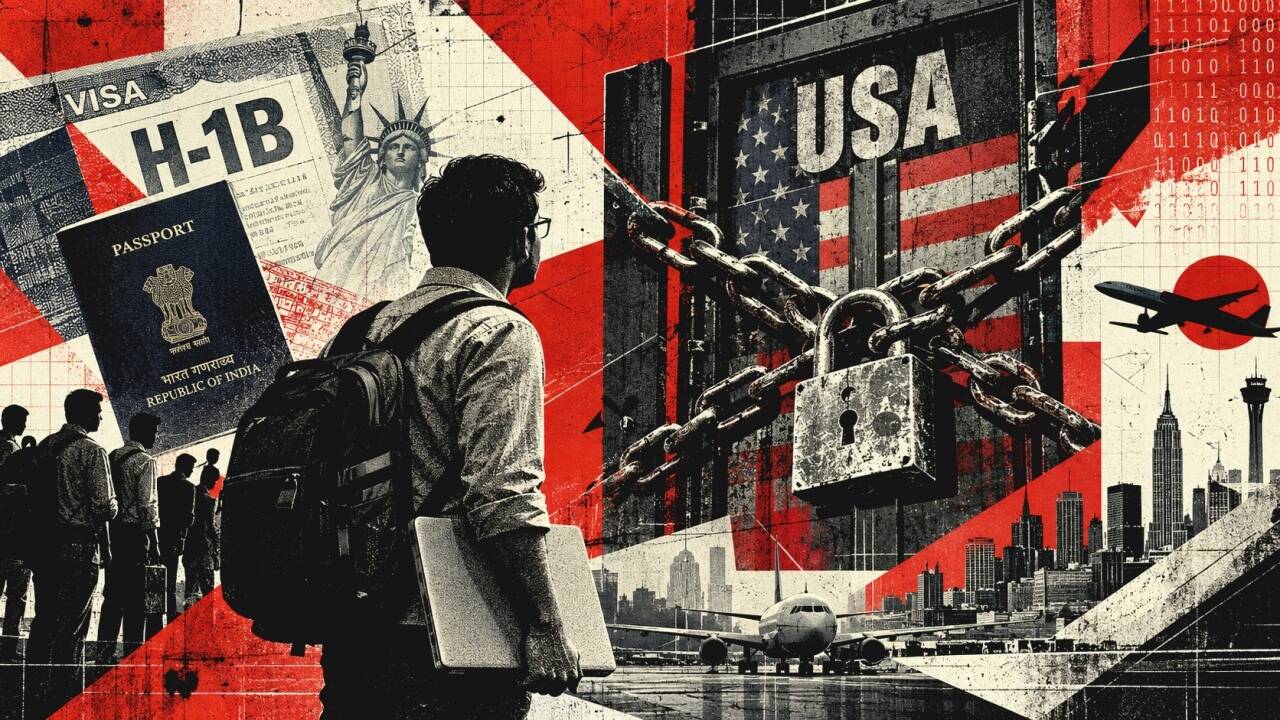
Indians, especially those in the IT sector, face a steep climb to work in the United States, and the Trump administration’s tightening of the H‑1B visa program has raised concerns that the path may be lost. Three changes to the H‑1B program are piling up: a proposed $100,000 fee, a wage‑weighted lottery that favors more senior workers, increased scrutiny of layoffs and compliance, and a new $70,000 fee for OPT/STEM‑OPT students. Statements from the administration have also hinted at eliminating the H‑1B system altogether. While experts say that is unlikely, they view it as a symptom of growing restrictions.
Indians account for about 70 % of all H‑1B approvals, making them the largest beneficiaries of the program and, consequently, the most affected by any tightening. The traditional pathway—Indian education, employment with an Indian IT company, H‑1B sponsorship, U.S. employment, and entry into the green‑card queue—may become narrower or disappear.
Rajiv Dabhadkar, founder of the National Organization for Software and Technology Professionals, explains that the changes reflect a broader U.S. labor‑market crackdown. He notes that the government is examining the entire employment chain: who sponsors the worker, who employs and controls them, where they work, the wages paid, and whether an American worker has been displaced. The 2010 Neufeld memorandum emphasizes the employer’s “right to control” an H‑1B beneficiary, a principle relevant to third‑party staffing arrangements.
In FY 2025, U.S. Citizenship and Immigration Services approved 406,348 H‑1B petitions, 283,772 (≈70 %) of which were for Indian beneficiaries. Technology occupations dominated the approvals, with computer‑related roles accounting for 252,088 (62 %) and systems analysis and programming the largest detailed occupation (50.4 %). The median annual compensation for all approved H‑1B beneficiaries was about $133,000, with computer‑specific roles at $140,000.
The impact varies by job level. Senior, highly paid Indian engineers are relatively insulated, as the wage‑weighting favors them. Early‑career Indian workers and those in the IT‑services staffing model, which relies on volume at lower wages, are squeezed harder by the flat fee and wage‑weighting penalties.
Litigation has become common. Two federal judges have blocked the $100,000 H‑1B fee, and business groups have challenged the administration’s authority. The broader issue is systemic uncertainty across multiple legal pathways.
Indian IT companies have already felt the effect. A recent report shows H‑1B registrations by TCS, Infosys, HCLTech, Wipro, LTM, and Tech Mahindra fell 92 % in FY 2027, from 21,919 to 1,763. The top seven Indian firms received just under 5,000 initial approvals in the most recent cycle, down roughly 70 % from FY 2015 and 37 % from FY 2024.
Experts say the traditional “body‑shop” model of flying Indian consultants to U.S. clients is being replaced by a mix of U.S. local hiring for client‑facing work and a larger offshore footprint in India for other tasks. The emerging model involves U.S. local employees, India‑based engineering teams, and global technology platforms.
While the H‑1B program is unlikely to be scrapped—its existence is codified in the Immigration and Nationality Act—alternatives such as the L‑1 intra‑company transfer, O‑1 extraordinary ability, and employment‑based green‑card pathways exist but have narrower eligibility and are not scalable substitutes for the large population of Indian professionals.
Beyond the U.S., countries like Canada, the U.K., Australia, Germany, Singapore, and the UAE continue to attract skilled Indian professionals through various work and residence programs.
Some experts see potential upside. Remote work could create more jobs in India, with software development, testing, and support services increasingly delivered from Indian delivery centers. A balanced approach—stronger U.S. local hiring for client‑facing roles, selective H‑1B sponsorship for critical skills, and expanded offshore delivery for roles that do not require physical presence—may emerge. This could lead to more engineering in India, more global capability centers, and higher‑value employment in both countries, according to Rajiv Dabhadkar and Akhil Chandna.
Frequently asked questions
What percentage of H‑1B approvals were for Indian beneficiaries in FY 2025?
About 70 % (283,772 of 406,348).
What new fees and changes are being proposed for the H‑1B program?
A proposed $100,000 fee, a wage‑weighted lottery favoring senior workers, increased scrutiny of layoffs and compliance, and a new $70,000 fee for OPT/STEM‑OPT students.
How did H‑1B registrations by top Indian IT firms change in FY 2027?
They fell 92 % from 21,919 to 1,763.