India
From Four Biplanes to Modern Fighters: The Indian Air Force’s 94‑Year Evolution
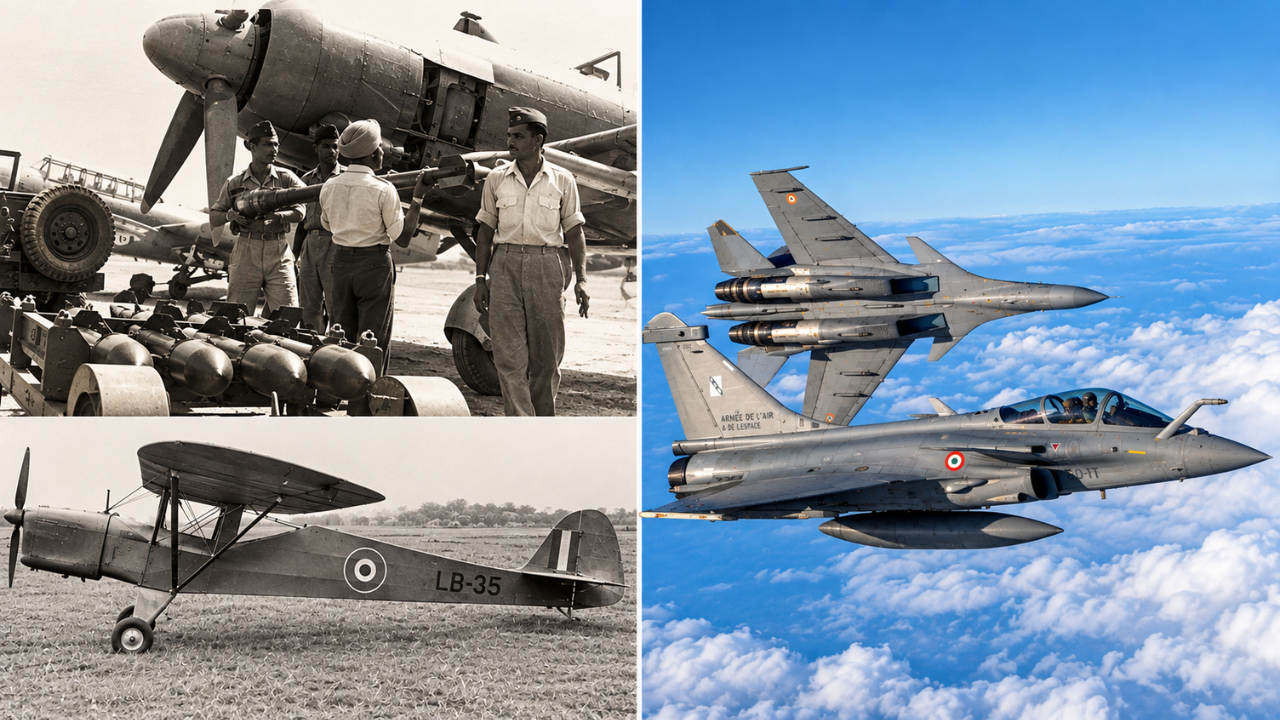
NEW DELHI – In 1933, the Indian Air Force (IAF) began with four Westland Wapiti biplanes, six RAF‑trained officers and 19 Hawai Sepoys, taking its first operational flight from Drigh Road in Karachi. The modest start would eventually give way to a fleet that includes Rafales, Su‑30MKIs, Mirage‑2000s, MiG‑29s, Jaguars and Tejas, supported by transport aircraft, attack and heavy‑lift helicopters, drones and a layered air‑defence network. The IAF celebrated its 94th anniversary on 8 October 2024.
**Early Years (1932–1945)** The IAF was formally established on 8 October 1932. Six months later, on 1 April 1933, the first operational flight was conducted by the small unit at Drigh Road. The four Wapiti IIA aircraft formed the nucleus of what would become No. 1 Squadron. In 1936 the force saw its first operational action from Miran Shah in North Waziristan, supporting Army operations against insurgent Bhittani tribesmen. By the outbreak of World War II the IAF consisted of 16 officers and 662 men. Coastal Defence Flights were created to protect key ports, and the fleet shifted from Wapitis to Tiger Moths, Westland Lysanders, Audaxes and eventually Hurricanes and Spitfires. By 1946 the IAF had about 28,500 personnel, including 1,600 officers, and had earned 22 Distinguished Flying Crosses.
**Post‑Independence and Reorganisation (1947–1962)** Independence in 1947 split the IAF’s assets between India and the newly formed Royal Pakistan Air Force, nearly halving its strength. Units were disbanded or transferred, and the IAF had to reorganise amid the Kashmir conflict. The fleet included Spitfires, Tempests, Vampires and the first jet fighters. In 1950 India became a republic and the “Royal” prefix was dropped. The IAF expanded to 15 squadrons and later to a planned 33‑squadron force, adding aircraft such as the Ouragan, Mystère IVA, Hunter and Canberra. The 1961 UN mission in Congo saw Canberras operating far from India.
**Modernisation and Conflicts (1965–1971)** After the 1965 India‑Pakistan war, MiG‑21FLs replaced older aircraft, and the Gnat returned to production. By 1968 four Gnat squadrons and the Su‑7BM had joined the fleet. The Air Defence Ground Environment System was planned, and the Air Force Academy at Dundigal opened in 1971. During the 1971 war the IAF flew thousands of sorties, achieving air superiority in the eastern theatre. The war demonstrated the effectiveness of a larger, better‑equipped force.
**Kargil and the Shift to Precision (1999)** The 1999 Kargil conflict required operations over high terrain. Operation Safed Sagar saw Mirage‑2000s conduct precision attacks and MiG aircraft provide support. Official figures report about 5,000 strike missions, 350 reconnaissance missions, 800 escort sorties and over 2,000 helicopter sorties. The conflict highlighted the importance of accurate navigation, intelligence and high‑altitude capability.
**Women in the IAF** Women officers joined the IAF in the early 1990s, initially in ground duties. In 2016 Avani Chaturvedi, Bhawana Kanth and Mohana Singh became the first women fighter pilots. Shivangi Singh became India’s first woman Rafale pilot, and Bhawana Kanth became the first woman IAF officer to qualify as a Fighter Combat Leader in 2026. Women have also led drill sequences and marching contingents during Air Force Day celebrations.
**Indigenous Development and Tejas (2016 onwards)** The Tejas Light Combat Aircraft, an indigenous design, entered service in 2016. It features digital avionics, fly‑by‑wire controls and composite materials. The Tejas Mk1A, with 64 % indigenous content and UTTAM AESA radar, is under a 2025 contract for 97 aircraft. Deliveries are scheduled for 2027‑28, though earlier orders for 83 Mk1A aircraft remain pending.
**Current Fleet Composition** The IAF’s fighter fleet includes Rafales, Su‑30MKIs, Mirage‑2000s, MiG‑29s and Jaguars. Transport aircraft such as the C‑17, C‑130J and C‑295 support logistics, while Apache and Chinook helicopters provide attack and heavy‑lift capabilities. The C‑295 programme involves 16 aircraft from Spain and 40 manufactured at Tata‑Airbus in Vadodara.
**Operation Sindoor (2025)** On 7 May 2025, the IAF launched Operation Sindoor after the Pahalgam terror attack. Nine terror infrastructure sites in Pakistan and Pakistan‑occupied Jammu and Kashmir were targeted. The operation involved a layered air‑defence network, with Akash, Pechora, OSA‑AK and the Integrated Air Command and Control System (IACCS). Indian aircraft struck 11 Pakistani airbases, including Nur Khan and Sargodha. The operation underscored the role of integrated networks in modern air warfare.
**Future Outlook** The IAF plans to integrate drones, loitering munitions, long‑range missiles, electronic warfare systems and advanced air‑defence networks. The Advanced Medium Combat Aircraft (AMCA) programme received an execution model approval in May 2025, allowing industry participation. In February 2026 the Defence Acquisition Council approved a requirement for additional Rafales, combat missiles and an airborne high‑altitude pseudo‑satellite system, with most aircraft to be manufactured in India.
From a handful of biplanes and Hawai Sepoys to a sophisticated, network‑centric force, the IAF’s 94‑year journey reflects the impact of wars, technological progress and continuous adaptation. The modern Indian Air Force continues to expand its capabilities and prepare for future challenges.
Frequently asked questions
What aircraft did the Indian Air Force start with in 1933?
Four Westland Wapiti biplanes.
When did the IAF celebrate its 94th anniversary?
8 October 2024.
What aircraft were used in Operation Safed Sagar during the 1999 Kargil conflict?
Mirage‑2000s conducted precision attacks and MiG aircraft provided support.