World
China Inaugurates Pinglu Canal, Enhancing Trade Routes to Southeast Asia
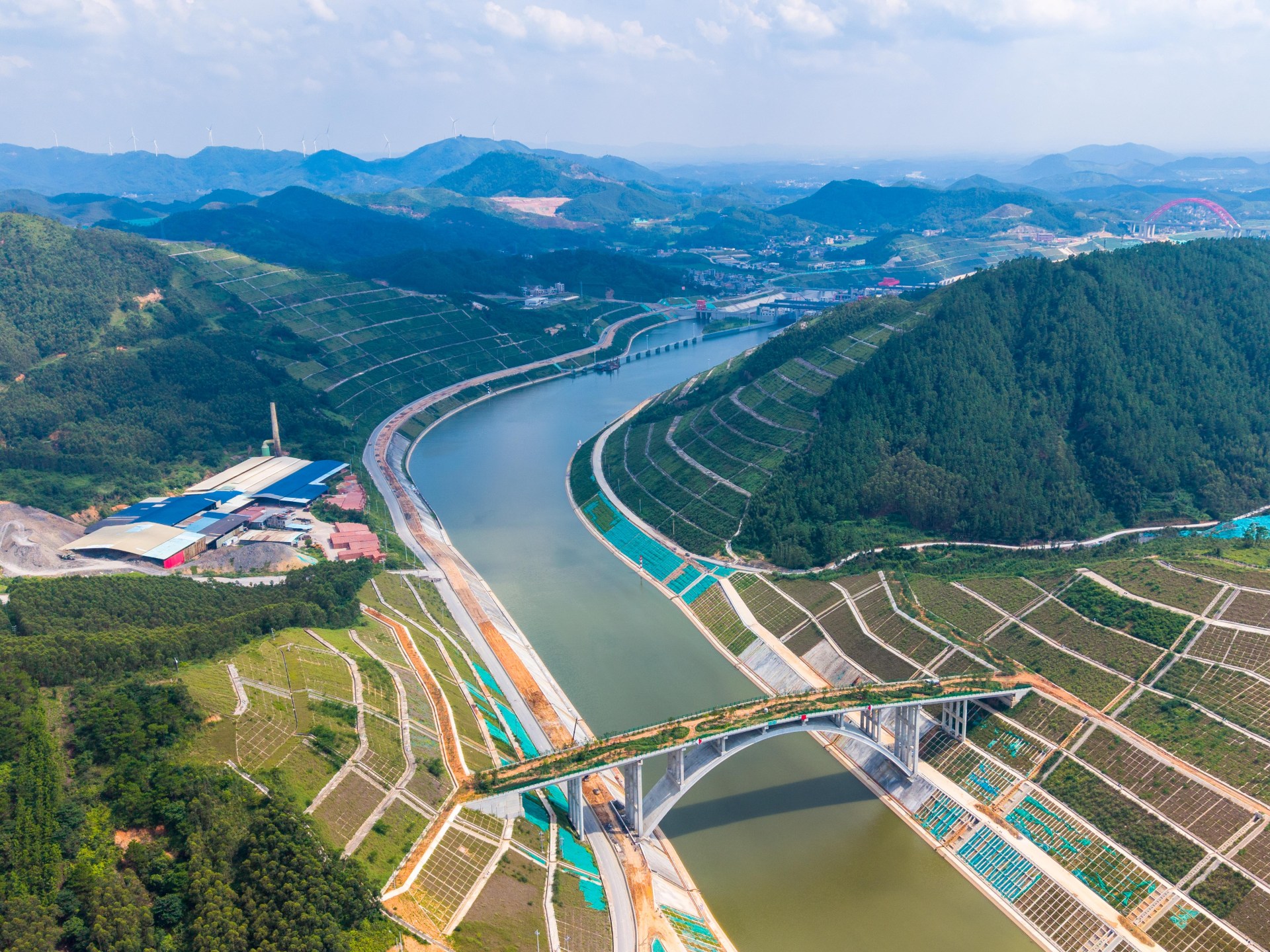
China has opened its first modern river-to-sea canal for navigation, the Pinglu Canal, on Wednesday. This project aims to significantly reduce shipping distances and costs between China's southern hinterland and Southeast Asia, a key trade partner. The canal, located entirely in Guangxi, a region bordering Vietnam and overlooking the South China Sea, is 134km (83-miles) long. It connects the Xijiang River with the Beibu Gulf, the northwestern arm of the Gulf of Tonkin, providing a shorter sea route for vast areas of southwest China, including provinces like Yunnan and Guizhou, to Asian markets.
The Pinglu Canal is the first such canal built by communist China and is part of the New International Land-Sea Trade Corridor. This corridor, involving southern Chinese provinces, aims to link western and southwestern China with Southeast Asian countries and global markets. The land-sea trade corridor is also an element of Chinese President Xi Jinping’s Belt and Road Initiative, which seeks to connect China with Europe and Africa through a network of infrastructure.
According to Guangxi authorities, the canal will shorten shipping distances between inland southwest China and Southeast Asian countries by approximately 560km (350 miles) and decrease logistics costs by 18 to 30 percent. Zhang Zhiwen, deputy secretary-general of the Guangxi government, estimates annual transport cost reductions exceeding 5 billion yuan (about $700m). Lu Xinning, the region's vice chairwoman, described these as “tangible gains” that will lower operating costs and boost trade. The canal is designed to accommodate ships with a capacity of 5,000 tonnes and has an estimated cost of about 72.7 billion yuan (approximately $10.8bn). This development will bring cities and industrial areas in southwest China closer to maritime trade routes. The new trade corridor extends beyond Guangxi, connecting to Chongqing, Chengdu in Sichuan province, Guizhou, and Yunnan, before goods reach Beibu Gulf ports and international markets.
This initiative coincides with rapid growth in China-Southeast Asia trade. China’s General Administration of Customs reported that bilateral trade in the first half of 2026 reached about 4.34 trillion yuan (approximately $640bn), an 18.2 percent year-on-year increase. Container-handling capacity at Beibu Gulf Port, at the canal's southern end, increased from 2.28 million TEUs in 2017 to 10.06 million TEUs in 2025, with a shipping network covering major Southeast Asian ports.
Guangxi is also developing a “Pinglu Canal Economic Belt” to attract industries, including non-ferrous metals, critical minerals, modern green chemicals, artificial intelligence, and information technology, along the new corridor. Industrial zones are being established near ports to reduce distances between production and shipping centers. Commercial activity has already begun, with a train carrying sodium bisulfate arriving from Chongqing at the port of Nanning. Direct commercial sailings to Can Tho in southern Vietnam are planned after the canal opens.
Operationally, Guangxi has implemented a tiered transit-fee system. Commercial vessels will pass through the canal's three water gates free of charge until December 31, 2026. Starting January 1, 2027, a trial fee of one yuan (about $0.14) per tonne of a vessel’s capacity will be charged for each passage, remaining in effect until September 2031. This system allows river vessels to sail directly to Qinzhou seaport berths, enabling seamless river-to-sea cargo transfer.
The canal project necessitated the relocation of 2,764 households, totaling 11,228 people, across four counties and county-level cities in Guangxi. In Hengzhou, 368 homes were demolished over 84,200 square meters (906,321 square feet), with 1,221 people temporarily resettled. The resettlement process involved financial compensation and the design of 21 different housing models to accommodate residents’ customs, including specific orientations for reception rooms, crop-drying areas, poultry enclosures, and agricultural chemical storage. In Shaping, residents received four-story homes covering 420 square meters (4,520 square feet), some with commercial storefronts. Despite a sense of loss, residents expressed hope for the future, with one former resident of Fenghuangping stating, “There is no longer a village called Fenghuangping, but with the Pinglu Canal, tomorrow will be better.” Some families moved seven-century-old trees, including a 217-year-old camphor tree. The resettlement, completed in 39 days, was linked to promises of construction jobs and vocational training for relocated residents.
The Pinglu Canal represents China's effort to create an alternative, shorter, and faster route to a critical market, addressing the vulnerability of global trade routes. This aligns with a global trend of countries developing alternative supply chains and transport corridors to reduce reliance on single routes.