India
India and US Armies Commence Annual Yudh Abhyas Exercise
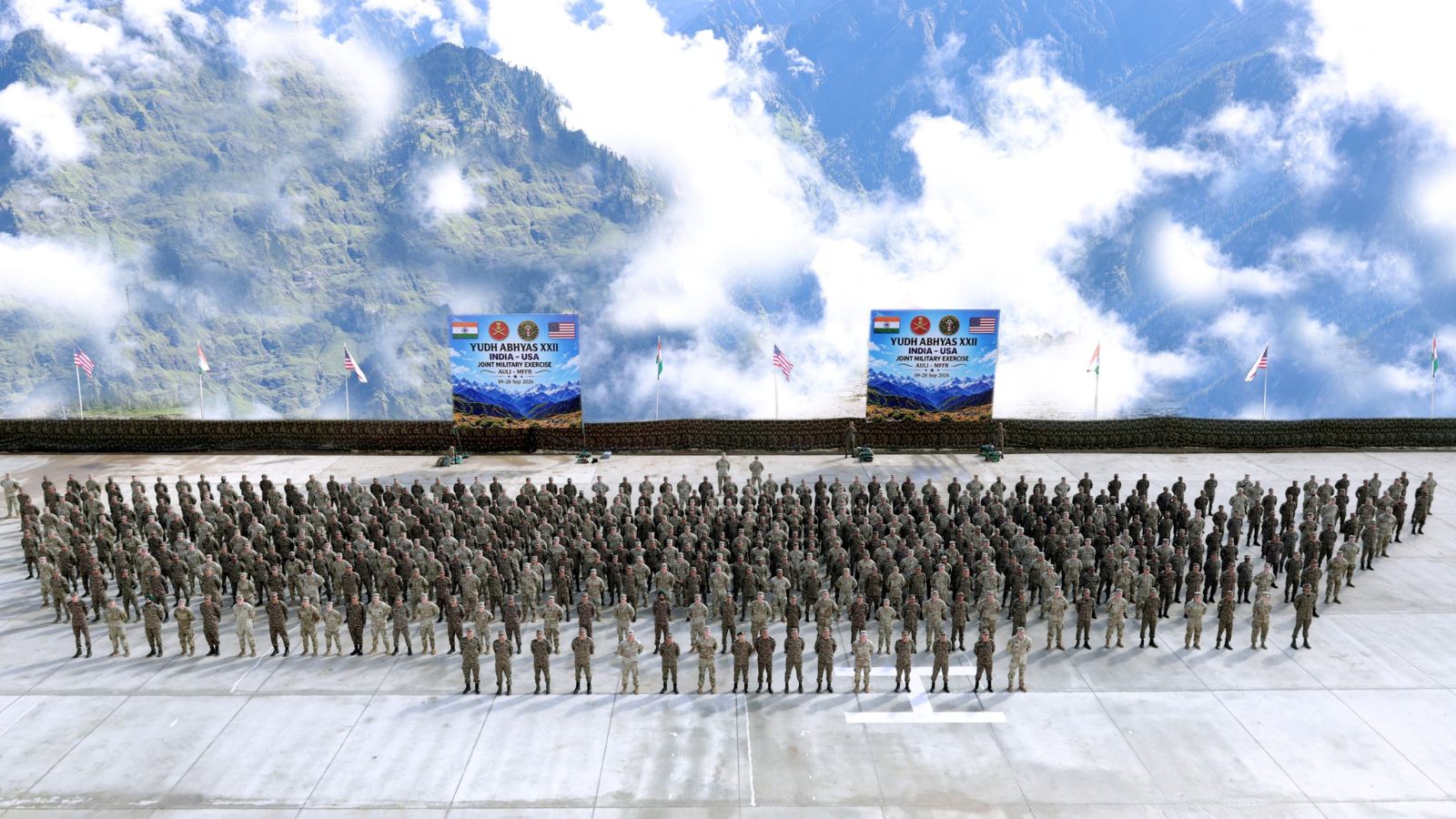
The Indian and US armies have initiated their annual bilateral military exercise, Yudh Abhyas, designed to enhance joint operational capabilities in challenging environments. This 22nd iteration of the exercise is being conducted at two locations: the Auli Foreign Training Node in Uttarakhand and the Mahajan Field Firing Range in Bikaner, Rajasthan. The opening ceremony took place on Tuesday at Auli. Major General Amaresh Gunjan, General Officer Commanding of the 14 Infantry Division, and Colonel Benjamin Jackman, Commander of the 1st Infantry Brigade Combat Team, 11th Airborne Division of the United States Army, addressed the participating contingents. Each side has contributed 600 personnel to the exercise. The US Army's 11th Airborne Division, known as the “Arctic Angels,” specializes in extreme cold-weather and Arctic operations. The Ministry of Defence stated that a primary objective of the exercise is to improve the joint military capability of both armies in deploying Integrated Battle Groups (IBGs) across mountainous and semi-mountainous terrain, with a focus on infantry-dominated operations. The exercise aims to strengthen interoperability, facilitate the exchange of operational best practices, and reinforce joint planning and execution. The Army had previously operationalized its first IBG from two divisions under the XVII MSC in July. Technology integration is a key focus area, according to the defense ministry. Training will incorporate drones and autonomous systems for surveillance and reconnaissance, alongside demonstrations of modern weapon systems at the Mahajan Field Firing Ranges. Experts from both armies will also discuss emerging technologies and advancements in multi-domain warfare. The exercise provides a platform for sharing tactics, techniques, and procedures, thereby enhancing the ability to conduct coordinated military operations across diverse terrains and operational settings. The US Army’s 3rd Multi-Domain Task Force (3MDTF) is also participating, introducing advanced long-range precision fires and integrated command-and-control systems into the bilateral framework.